Tuesday, 29 March 2016

The end of the bones


Bone Detectives 
for 
British Science Week, 
12 - 20th March 2016


There were bones, and teeth, there were skulls and even the fragmented paw of a cave lion. And there was time to look, to handle , turn over, touch, test a fingertip against a crocodile’s tooth.

Time to talk, wonder, ask and ask again and say, “No!” and “What’s a hyrax?” and
“This is a porpoise?”
“Where is the elephant’s trunk?”
“Can I pick this up? Oh. Can I pick that up? Good”

There were beautiful replica skulls for the slightly squeamish and gloves for the bolder – or for anyone who just wanted to look sort-of-scientific like they were on some police procedural drama

For British Science Week, in a collaboration between Stone and Water, Buxton Museum’s Collections in the Landscape project and Creeping Toad, we ran a series of “Bone Detectives” workshops. These set out to introduce people to some basic skull features to look for and understand the clues they can give us about the original animal. The thought was that this would encourage people to look – to really open their eyes when they are out or maybe even to set off and do the hopeful walk they wouldn’t have done before

Skulls, skeletons or bits often turn up on walks over the moors of the Peak District, or perhaps are found by someone strolling in a casually acquisitive manner along a beach. We were looking for the questions (and their answers) that would set some inspired investigation in motion. We concentrated mostly on British mammal skulls – given time and the scope of vertebrate anatomy we had to draw some lines somewhere. But there were extension opportunities and as confidence grew, participants could move onto British bird skulls, a few exotic extras – a crocodile, assorted horns, replica hyrax, lynx and wallaby* and a wide selection of shells including a spread of annoying cone shells (this one? That one? No, the other one? Why would you call something a geographical cone, for goodness sake”. There was even a d-i-y snake spine

The workshops were a delight: from keenly questioning WATCH members to the surprise of casual visitors, workshops invite participation and challenged preconceptions. “But it’s so small! “ (same comment applied to rabbit, rat and squirrel skulls). People brought their own puzzles with them: beautfully delicate mouse and hedgehog skulls, a mysterious jaw bone (probably sheep), the museum added some mind-boggling teeth: woolly rhino and hyena.

The very bold in the museum went off to find the cave bear skull

We were pleased: these were sessions that maybe didn’t get quite the quiet, dedicated concentration we had imagined but they were sessions that got people handling material, talking, asking questions, feeling more confident.

Sources:
Just to be clear, the skulls and shells we sued were all found materials or were already in established collections. Nothing was killed for the sake of this project

Reproduction skulls came from a wonderful online shop: CrimsonRichDesire

* and, yes, we know we had a small population of feral wallabies until recently in the Roaches. Sadly missed


Monday, 28 March 2016

House of Wonders, public event


The House of Wonders
Wednesday 6th April
Castleton Visitor Centre


 a short expedition into the world 
of personal, portable museums


Between 1926 and 1978, the Douglas House of Wonders in Castleton offered visitors a wonderful collection of curiosities from a motor that could fit into a thimble to the Lords’ Prayer written on a thread thin enough to pass through the eye of a needle. There were minerals, native spears, and a selection of locks and keys that were featured in the BBC’s A History of the World in 100 Objects. Randolph Douglas was also an accomplished escapologist who worked with Houdini but we’re not going to ask you to go down that path on this workshop!


Inspired by the original Douglas House of Wonders museum in Castleton, join artists from Buxton Museum’s Collections in the Landscape project to make your own Cabinet of Curiosity or set out to find the lost scenes from Castleton.

Victorian and Edwardian Cabinets of Curiosity were personal museums with collections that ranged from local fossils and shells to exotic trade beads and even shrunken heads from distant travels. In size, these Cabinets could be free standing glass display units or small glass-fronted cupboards mounted on a wall. In effect anything could become a “Cabinet” if it offered a space that could hold a selection of items. While at one level being simply collections of odd bits and pieces, Cabinets are also reflections of an individual’s interests and travels, offering glimpses into the interests and fascinations of Victorian society and the personal lives of their owners.


We’ll use folding cardboard boxes as bases, cutting windows, adding acrylic sheets, hidden pictures and museum trays to make compartmented boxes to hold collections of small objects. You might go looking for shells and fossils, find a special leaf or a precious feather and store your mementos and souvenirs in your own portable museum.


There will also be a selection of period pictures to use, inviting you to explore Castleton and the Hope Valley and try to find those same places a century later. If you send us those 21st century photos we will build a project Gallery of Changes


Where: Castleton Visitor Centre, Buxton Rd, Castleton, Hope Valley, S33 8WN

Times: 11 – 1 and 2 – 4: allow 45 minutes for your visit

Bookings? These sessions are free and no booking is needed, just drop by and join in. Car parking charges may apply


what would you put in your Cabinet?

(The two Cabinets here are from the Creeping Toad collections rather than anyone else's!)


Saturday, 26 March 2016

Store rooms!


Embracing change: 
the battle for Store Room 2

the approach

I know there was progress. No-one else might have noticed it, but I know Useful Changes Happened

a first look
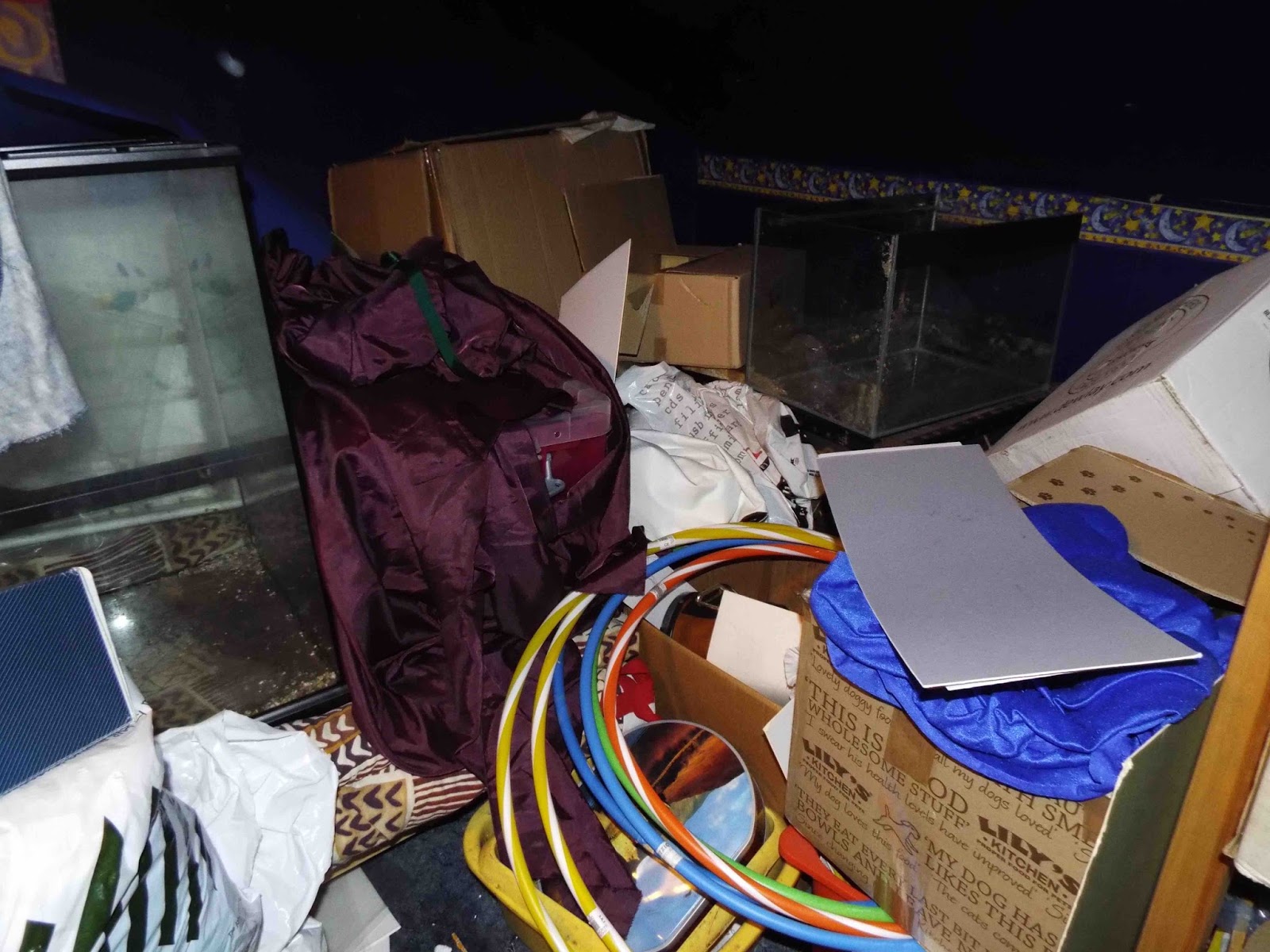
Over the last year I have been making not-frequent-enough and not-nearly-ruthless-enough forays into my store rooms to try to pull them into some sort of useful organisation. This week-end, I am turning my attention to Store Room 2….


The supporting team - a sort of Greek Chorus of woe and misadventure

You never know what is going to turn up:  an unexpected squid, a whole big bag of fur-fabric scraps, a box of buttons, some Skull-and-Crossbones bunting


There are also, in this room alone, 5 empty fishtanks and 1 usefully sized vivarium. Oh, dear. I can already hear the “pond in a bedroom” argument unfolding and know that I’m not good at resisting…..

Work is progressing. The carpet Has Been Revealed. Stray piles of mounting board have been pulled together into a single pile, ribbons compelled into a box. 


an unfortunate encounter with a tassle anemone

The Action Men found a Treasure Chest (empty). 

a promise of treasure

Tomorrow we have hopes of Reaching the Fossils and possibly Organising the Stone Boxes
progress?


Tuesday, 15 March 2016

Bone Detectives


Our Bone Detectives workshops have been galloping along with much excitement and(as yet) no casualties…we have encountered the sharp teeth of lynx and crocodiles, we’ve wondered about the impact of a buffalo charge and the strength of bite of badgers…

Wallabies and hyrax skulls have caused much confusion and a white-tailed sea-eagle wonder

And our visitors have enjoyed themselves....

As I want to be a vet as a job I found it a very good learning experience

It was really fun and interesting, wish they would do something like it again
  (both from Whistlestop Watch group)


investigation
So far, we’ve seen 60 visitors at Buxton Museum and Art Gallery, 32 with Derbyshire Wildlife Trust’s Whistlestop Watch and 23 with the 1st Taxal Cubs

There is one more chance to join in (at least for now)
not so sure about a mug of tea among the bones...

Wednesday 16th March: Bone Detectives, 2:at Buxton Museum and Art Gallery, Terrace Rd, Buxton, SK17 6DA, Tel: 01629 533540. 1 session: 10am - 1pm
This is a free session with activities and delivery aimed more at adults or young people of secondary school age
Again, this workshop is free and visitors are welcome to drop in. We recommend allowing an hour to work through activities but you are welcome to come for longer and spend more time handling, drawing and talking about the bones, skulls and shells we will have on display

Visitors are welcome to bring their own clean mystery finds with them - with no guarantee that we'll be able to solve the mystery but have confidence that we will be enthusiastic about them! (Whistlestop mysteries included an ichthyosaur rib, the lower jaw of a sheep and some crumbling mouse bones)
extra research
Community group Stone and Water have been supported by British Science Week in presenting these workshops


Friday, 26 February 2016

A few more bones

A few more bones

without apology, I enjoy bones. I have a pile of skulls, shells and bones in the living room complete with festive toadstools and twinkly lights (is it any wonder I live alone with axolotls and fish?)

And with Bone Detectives brewing, I've dug out a couple of ol' bone poems. Enjoy, dismiss or ignore, it's your choice

SOCKET

The sweep of the sky,
The rain's bow,
The curl of a wave,
The sand's dune,
All contained in
The scoop of an eye's socket,
And the bowl of a skull.
A world cradled in
My electric palms


first published in Old stones and ancient bones: poems from the hollow hills, by Gordon Maclellan (me!)


and here is The Bone Pit, written as part of a narrative poem for Buxton Museum's Wonders of the Peak audio trail


THE BONE PIT
A drumming thunder of running hooves, a racing sweep over the hilltops.
Steaming breath, rolling eyes, the wind flare of mane.
The heart beats quicker, hooves before paws, before claws, before teeth.

         Remember those who have gone.
         Bone upon bone,
         Rattle and fall,
         Tooth and horn,
         Fang and jaw,
         Warm flesh, fur and feather all grow cold
         Together in the bone-pit darkness

And wait.
Wait for a pick, for a shovel and a gentle touch
To lift the darkness of 10,000 years.

10,000 years is not so long.
We can look up and out, beyond these Buxton walls
And see the hills the old animals saw.
The folded dales may remember them yet and
All those we have lost may
Still walk in the dreams the land is dreaming.

         Aurochs, giant deer, bear, lion, and mastodon,
         Remember those who have gone.
         Bone upon bone,
         Rattle and fall,
         Tooth and horn,
         Fang and jaw,
         Warm flesh, fur and feather all grow cold
         Together in the bone-pit darkness


Haregate Hall and crystals

Haregate Hall and stray minerals


wet tissue picture of a geode

The lively lovelies of Haregate Hall are back!
a line-up of the usual suspects
a meoment ind evelopment
After the dramas of our last Haregate entry, the Cast have glued themselves together a bit more and relationships are clearly developing...

Unfortunately, this was just a short series of workshops and my time has finished...I may never know what happened ot Lady Mary Dovery-Little, and the Brigadier and this ominous looking bishop....


This post is a bit of a chance to catch up on images. As well as the last Haregate ones, I've had a few pictures back from people who joined in Marvellous Minerals
 at Buxton Museum earlier this month
crystal picture in window
Borax and copper sulphate crystals


 With so many thanks and much laughter to the Borderland Voices Art Club and the mad scientists of Marvellous Minerals


Bone Detectives


Bone Detectives

March 2016


As part of my ongoing work with Buxton Museum and Art Gallery’s Collections in the Landscape project, I have been organising some events for British Science Week. Here, we’ll be becoming natural historians, working with the skills that the early collectors who set the Museum Collections in motion used as they foraged across the peaks, rummaging in bone-pits, excavating a bit too enthusiastically at times in barrows, and generally being inquisitive and over-excited. This will also be part of an underlying thread setting out to encourage a sense of investigation, to question what is appropriate when collecting, and to get people looking, thinking, talking to each other. In April, at Castleton Visitor Centre (details will follow here very soon!), we’ll be making small Cabinets of Curiosity to start some portable museums in motion

a beautiful replica lynx skull*
Discovering the secrets of the skulls
Here are the clues that will help you identify the mysterious skull you found on the beach or the bones on the moor, or perhaps here is simply the skills to exercise a fascination with ancient remains, old bones and hidden histories
When we examine a skull, we can tell a lot of an animal’s story: diet, behaviour, age, senses: the clues are all there for the skilled osteologist to read
These workshops will introduce participants to some of those skills, offering activities and inviting questions, setting an investigative procedure in motion so that even if we know what the animal is, we can still find out more

Materials:
there will be skulls to handle, gloves to wear (for the wary), plastic skulls as back-up, paper to draw on, pencils, etc to draw with, information sheets to work on and keep

PUBLIC EVENTS
Saturday 12th March: Bone Detectives, 1: at Buxton Museum and Art Gallery, Terrace Rd, Buxton, SK17 6DA, Tel: 01629 533540. Sessions 10 - 12, 1 - 3

Free, no booking needed, children 7 years and under need to bring an adult and squeamish adults probably need to be accompanied too

These sessions are aimed at family groups

Wednesday 16th March: Bone Detectives, 2: at Buxton Museum and Art Gallery, Terrace Rd, Buxton, SK17 6DA, Tel: 01629 533540. 1 session: 10am - 1pm

This is a free session with activities and delivery aimed more at adults or young people of secondary school age

Again, this workshop is free and visitors are welcome to drop in. We recommend allowing an hour to work through activities but you are welcome to come for longer and spend more time handling, drawing and talking about the bones, skulls and shells we will have on display

Visitors are welcome to bring their own clean mystery finds with them - with no guarantee that we'll be able to solve the mystery but have confidence that we will be enthusiastic about them!

Our wonderful friends in the community group Stone and Water have achieved a grant from BSW towards the community participation in these events and to cover the costs of a similar session with a youth group. In fact, we’ve got 2 – so a local WATCH group is going to be going all skeletal and what will happen to Taxal Scouts, I almost dread to think.

These events are supported by BritishScience Week and are also part of Buxton Museum's Collections in theLandscape project

The replica skulls I'm using come from  an e-bay shop with the exquisite name CrimsonRichDesire. Go on. Indulge.

replica skulls come from Crimson Rich Desire